
What Is a Cataract?
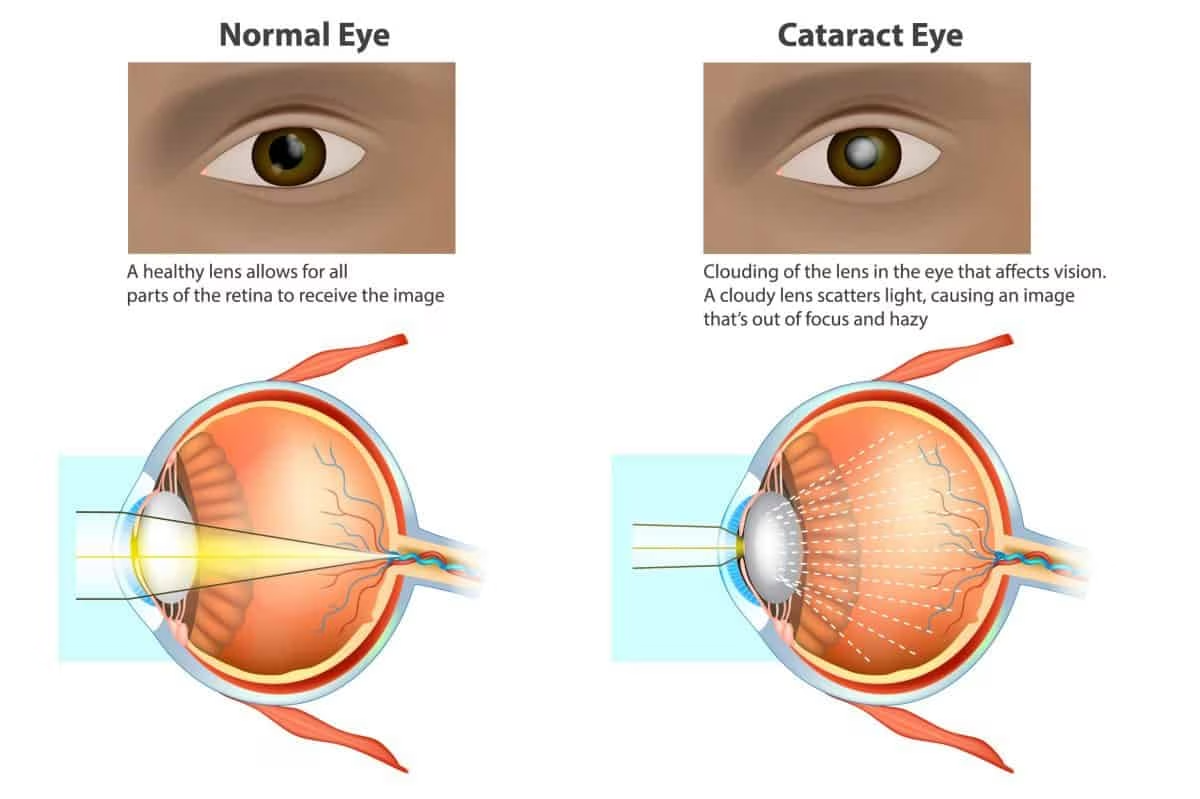
A cataract occurs when the clear lens inside your eye becomes cloudy, making it difficult for light to pass through and focus properly on the retina. This can cause blurry vision, glare, faded colors, and difficulty seeing at night.
Everyone eventually develops cataracts, and ophthalmologists usually start seeing some clouding of the lens in your eye around the age of 50-60. Cataracts typically develop slowly over time, and while they are most often related to aging, they can also occur earlier due to other factors.
Who is at Risk for Cataracts?
While everyone eventually develops cataracts, certain factors increase your risk and make them progress faster:
- Diabetes: High blood sugar can accelerate lens clouding.
- UV Exposure: Prolonged sunlight exposure without proper eye protection can lead to cataract formation.
- Smoking: Tobacco use increases oxidative stress in the eye, which can lead to cataracts.
- Certain Medications: Long-term steroid use, for example, may increase risk.
- Eye Injury or Surgery: Trauma or previous eye operations can lead to cataracts.
How are Cataracts Treated?
Glasses/Contact Lenses:
As cataracts grow, they change your glasses prescription. In the early stages, updating your glasses or contact lens prescription will improve vision. Anti-glare lenses and brighter lighting can also help manage symptoms. However, as cataracts progress, glasses alone will no longer restore clear vision – that’s when cataract surgery becomes the best option.
Cataract Surgery: Safe, Effective, and Life-Changing
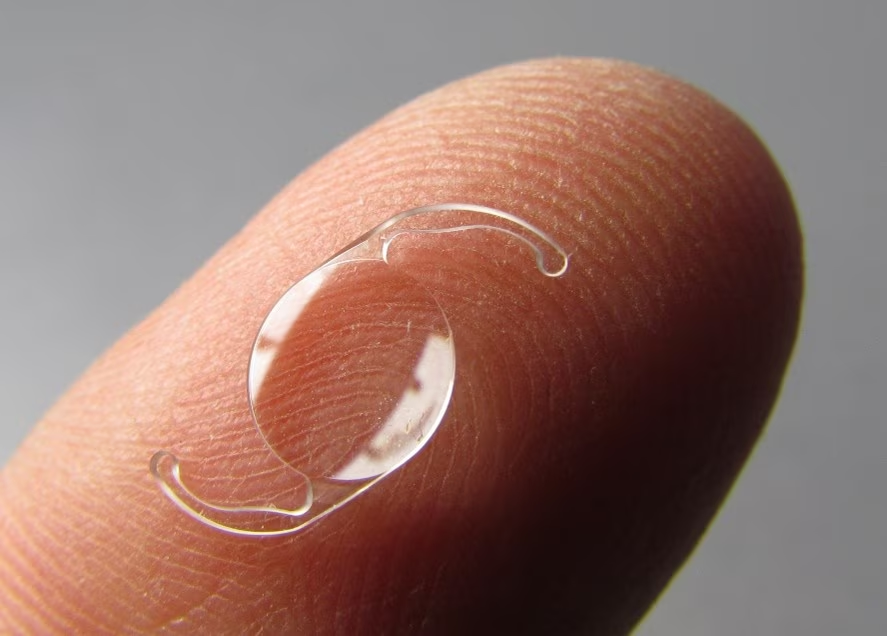
Cataract surgery is one of the safest and most common procedures performed worldwide. During surgery, the cloudy lens is removed and replaced with a clear artificial lens, known as an intraocular lens (IOL).
The time to do cataract surgery is when glasses can no longer correct your vision to an acceptable level and when your vision begins to interfere with your daily activities.
The procedure typically takes about 15-30 minutes. You are awake during cataract surgery, but you can receive relaxing medications through an IV to keep you comfortable and worry-free. Your eye is numbed with drops for surgery, so the procedure is painless. During surgery, you are looking at your surgeon’s bright microscope light, so you do not see anything coming at your eye. Most people just see shadows, colors, and sparkly lights during surgery.
Most patients notice improved vision within days once the eye inflammation and swelling improve after surgery. Recovery is usually quick, with minimal discomfort.
What Intraocular Lens Should I Choose For Cataract Surgery?
Modern cataract surgery offers a variety of IOL options to fit your visual needs. Your ophthalmologist will help you choose the lens that best fits your visual goals, lifestyle, and eye health.
Standard Monofocal Lenses:
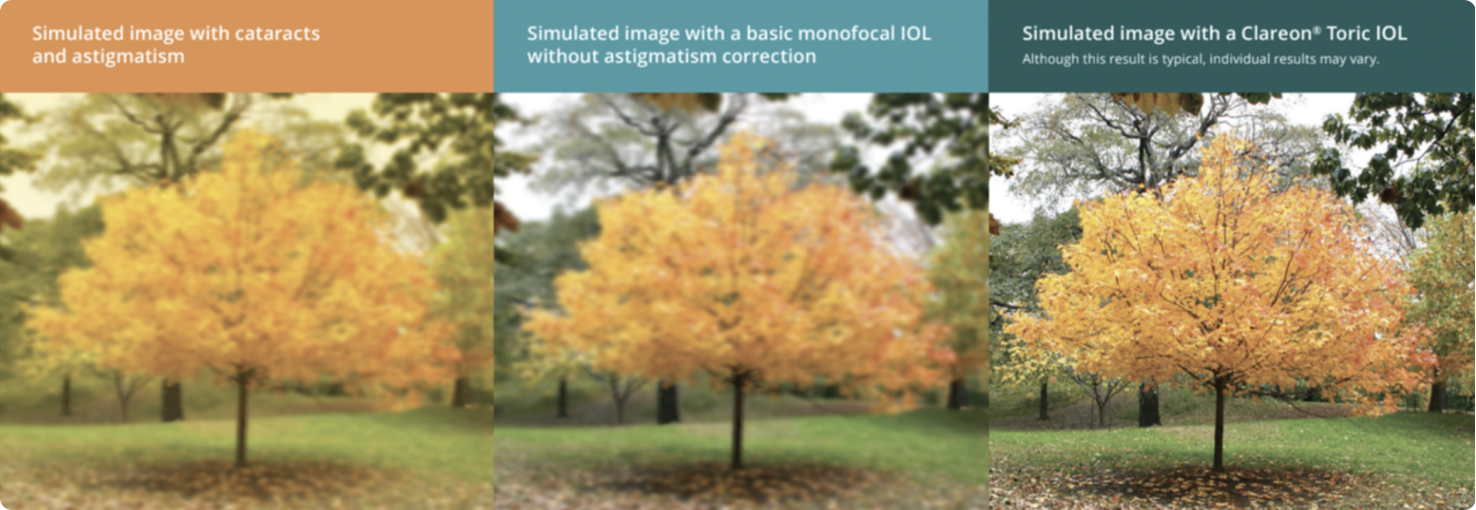
This is the most common choice for patients. It is covered by insurance with no out-of-pocket cost to you. It does not correct astigmatism, so if you have astigmatism, you will likely need glasses for far, intermediate, and near after surgery for sharp vision. If you do not have astigmatism, this lens can provide you with crisp vision at one distance (far, intermediate, or near) without glasses.
Most patients choose a standard monofocal lens focused on distance. You would be able to see clearly for driving and walking around, but you would require reading glasses to see up close.
Toric (Astigmatism-Correcting) Lenses:
Astigmatism deals with the shape of your eye. If you have astigmatism, you may qualify for a toric lens. Similarly to the standard monofocal lens, the toric lens corrects vision at one distance (far, intermediate, or near) without glasses. Choosing a toric lens will maximize your glasses-free vision if you have astigmatism. There is an out-of-pocket cost for this lens that insurance does not cover.
Multifocal Lenses (Astigmatism-Correction Included):
The goal of a multifocal lens is maximum freedom from glasses. Multifocal lenses allow each eye to see far, intermediate, and near. Sometimes, patients still need reading glasses for small print or in dim-light environments. To achieve this range of vision, these lenses diverge light, which can lead to a loss of contrast sensitivity and mild decrease in vision quality. These lenses also can lead to glare and haloes around lights. With multifocal lenses, you are compromising to achieve a greater range of vision with a slightly lower quality of vision.


If your cataracts are already causing issues with glare/haloes, we do not recommend a multifocal lens, since it may not resolve that issue. These lenses are also not a good option for patients with certain eye diseases (severe dry eye, corneal irregularity, retinal disease) since they will not work as well. There is an out-of-pocket cost for this lens that insurance does not cover.
Extended Depth of Focus Lenses (Astigmatism-Correction Included):
This is another option to maximize freedom from glasses. These lenses give you some range of vision, but not as much as multifocal lenses. With not as much range, the quality of vision is superior to multifocal lenses. These lenses are a good choice for monovision, where one eye can see clearly from distance to dashboard range, and the other eye can see clearly from dashboard to near range. With monovision, you are glasses independent in most settings. There is an out-of-pocket cost for this lens that insurance does not cover.
Light-Adjustable Lenses:
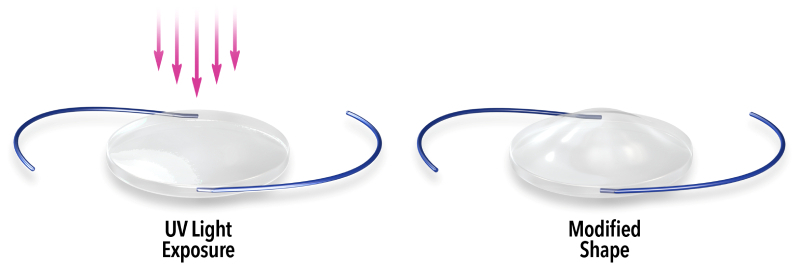
The light-adjustable lens allows patients to “test-drive” their vision postoperatively. The lens placed in your eye during surgery can be changed with light treatments after surgery to fine-tune your vision. These light treatments allow you to be more glasses-independent after surgery. This option gives us the most precise cataract surgery outcomes to date.
Most often this option gives you a mild version of monovision, with one eye seeing clearly at distance and the other seeing clearly at near. If you feel like your reading is clear after surgery but not at the right distance, we can treat the lens with UV light to fit your needs. You will have more visits after surgery than a typical cataract patient due to the nature of needing light adjustments. There is an out-of-pocket cost for this lens that insurance does not cover.
Schedule a Cataract Evaluation Today
If you’re noticing cloudy or blurred vision, difficulty with night driving, or increased glare, schedule a cataract evaluation at Ophthalmology Associates, S.C. Our team will perform a thorough eye exam and guide you through every step of your personalized treatment plan.