
Contact Lens
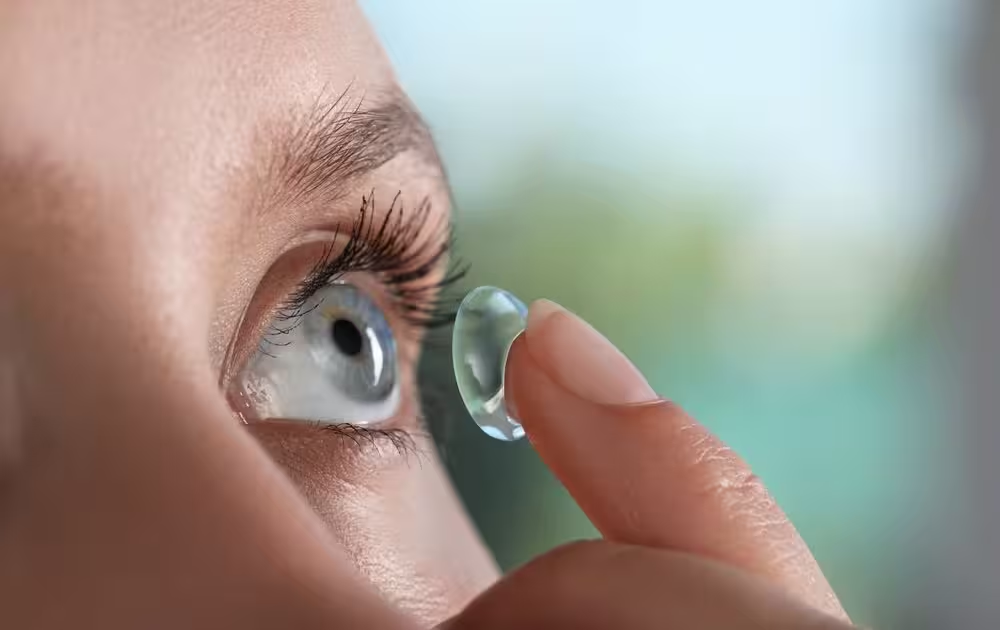
Most people have heard of soft disposable contact lenses. They either know someone who wears them or they wear these lenses themselves. There are different types of disposable lenses for frequent replacement (such as every day) or less frequent (every 3 months). They can correct astigmatism, presbyopia (the need for reading glasses) or even change your eye color. And even for high prescriptions, soft disposable lenses often fit the bill. For exceptionally high prescriptions, made-to-order soft contact lenses can be prescribed as well.
But what about when soft contact lenses do not work? This is when specialty contact lenses may be the right choice. There are several types of specialty contact lenses, but today’s blog will focus on three main types: corneal rigid gas permeable (RGP), hybrid (soft and rigid in one lens), and scleral RGP.
Corneal RGP lenses
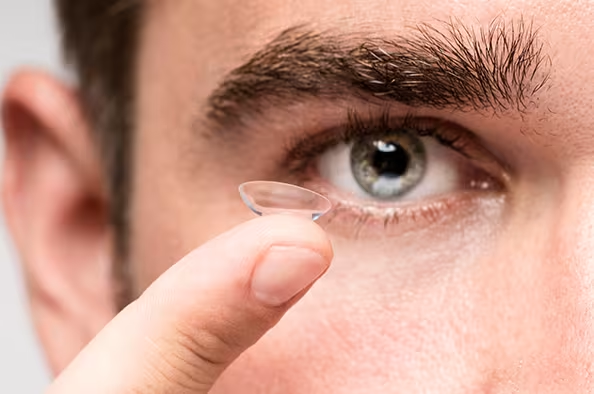
Corneal RGP lenses are small diameter lenses made of a rigid material that is permeable to oxygen. Unlike hard lenses of many decades ago, which did not let much oxygen into the eye, modern corneal RGP lenses have an array of oxygen permeable materials depending on the patient’s specific condition and oxygen needs. These lenses are placed directly on the cornea, and they are small in diameter such that no part of the lens edge will touch the sclera (white part of the eye). This type of lens can provide clearer vision than soft lenses for people with high prescriptions. It can also correct visual issues from conditions such as keratoconus, a condition which causes a warp in the cornea, corneal scarring, and other conditions which affect the shape of the cornea. The reason corneal RGP lenses can improve the vision in these conditions is because the rigid material masks any irregularities of the cornea under the lens.
The lens actually floats on the eye, with tears filling in the void under the lens. This allows for a smooth anterior surface of the eye, which is ideal for refracting light to provide a clear image. A downside to this type of lens is the comfort. Because they have a smaller diameter than the cornea, every time a patient blinks, the lid will go over the edge of the lens. This can take several weeks for the patient to adjust to. Also, for more advanced cases of corneal irregularities, this type of lens may decenter and may come off of the eye.
Hybrid lenses
Similar to corneal RGP lenses, a hybrid lens has a rigid center; however it has a soft “skirt” surrounding the rigid center. This type of lens is used in the same conditions as corneal RGP lenses, but allows for better centration when a corneal RGP lens fails and is more comfortable at the outset. For some conditions, especially moderate to advanced keratoconus, a corneal lens may not center correctly on the eye, and it may even pop off the eye on occasion. In those scenarios, a hybrid lens will work well. The diameter of this lens can be quite a bit larger than a corneal lens, which allows for a better-fitting lens in conditions that affect the peripheral cornea. Depending on the type of hybrid lens prescribed, some brands need to be applied in a face-down position with preservative free saline in the bowl of the lens. Other types of hybrid lenses do not require saline for application. A downside to this type of lens are that the soft skirt can sometimes rip.

Scleral lens
Another type of specialty contact lens is a scleral lens. This is a large diameter RGP contact lens with no soft skirt. It is called a scleral lens because the edges of the lens rest mostly or entirely on the sclera. The advantages of this lens are the same as for the hybrid lens, but these lenses are more customizable, allowing for visual correction of a larger number of conditions. Additionally, they are typically very comfortable and stable on the eye. There is a steeper learning curve to application and removal of this type of lens (the lens is filled with preservative free saline and applied in a face-down position with a plunger; it is also removed with a plunger) but most patients have no problem learning how to handle these lenses with proper training. Scleral lenses can require more eye doctor visits than other lenses to optimize the lens fit and vision, but the payoff is definitely worth it, especially for patients who have severe corneal irregularities.
The doctors in our offices who provide specialty contact lens care are Dr. Emmylou Swartz and Dr. Qian Yang.